Methods
Classical reproduction
All 1,546 Set-A records pass through preprocessing, QRS detection, feature
construction, grouped splitting, and model evaluation. The paper-aligned path
uses wqrs and EP Limited/Hamilton detectors through
wfdb-qrs-kit.
flowchart TD
  A[Set-A at 500 Hz] --> B[Grouped train / validation / test split]
  B --> C[Train-only class construction]
  C --> D[Resample to 125 Hz]
  D --> E[Two QRS detector families]
  E --> F[84 lead-specific SQI features]
  F --> G[RBF-SVM and LM-MLP]
  G --> H[Paper tables and subgroup audits]
The work is a functional reproduction, not an exact replication. The original adjudicated record- and lead-level labels were unavailable, so public binary Set-A labels and a grouped frozen split were used. This distinction limits the strength of direct paper-level claims.
Poor-domain audit
The balanced unacceptable class contained 225 native poor and 548 synthetic poor records. The audit evaluates:
- PCA support overlap;
- classifier two-sample tests in raw waveform and SQI space;
- RBF maximum mean discrepancy;
- directional transfer between native and generated poor sources;
- source-stratified recall at frozen operating points.
This sequence distinguishes aggregate accuracy from genuine transfer to naturally poor ECGs.
Train-only support-aware construction
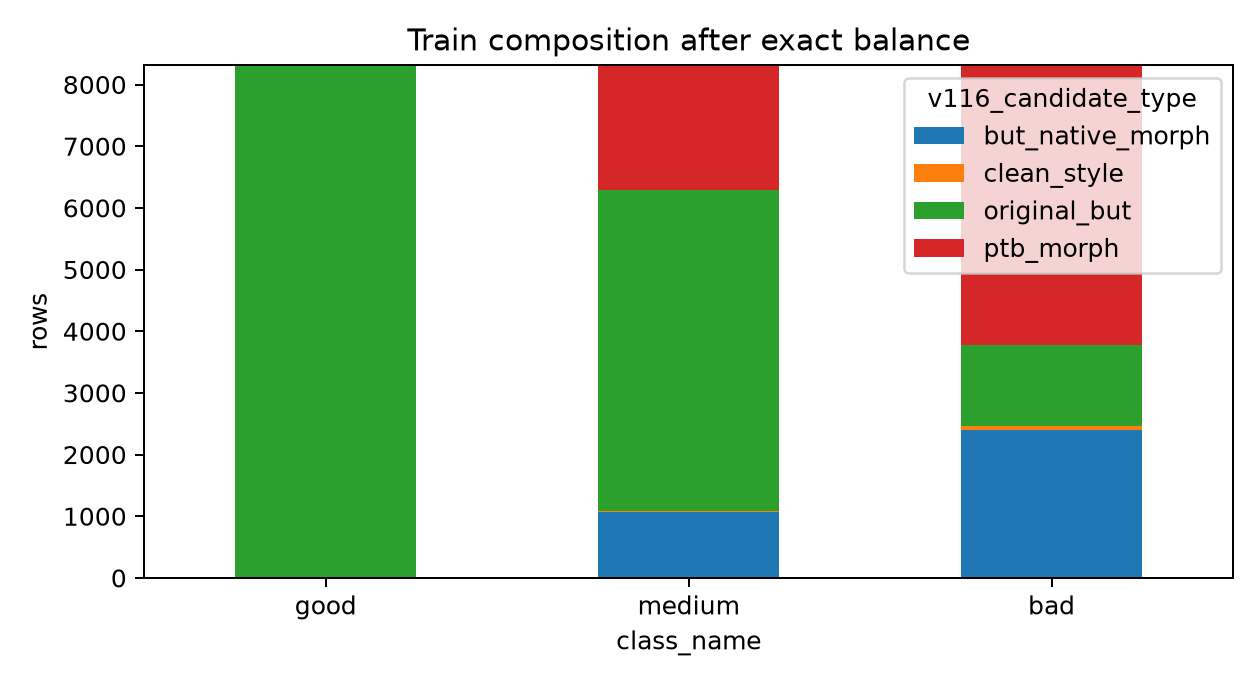
The extension builds a broader candidate bank using native morphology and clean carriers, then applies donor, patient, severity, and support-bin constraints. Sequential Monte Carlo (SMC) selects a balanced proposal set; a constraint-matched random baseline tests whether improvement comes from the candidate bank or from SMC itself.
Local quality evidence
The representation comparison is hierarchical:
- whole-record SQIs test global summary features;
- local-window SQIs add temporal localisation;
- waveform models preserve continuous morphology;
- ResNet/Conformer and component controls test architecture attribution.
Aligned native BUT test rows and paired subject-level uncertainty are used for the model contrasts. This makes the stable claim about representation, while keeping the architecture-specific claim conditional on the dataset.
Code mapping
The classical orchestration is exposed through
SQIPipelineConfig and run_pipeline.
Frozen prediction uses the smaller, stable
inference API.